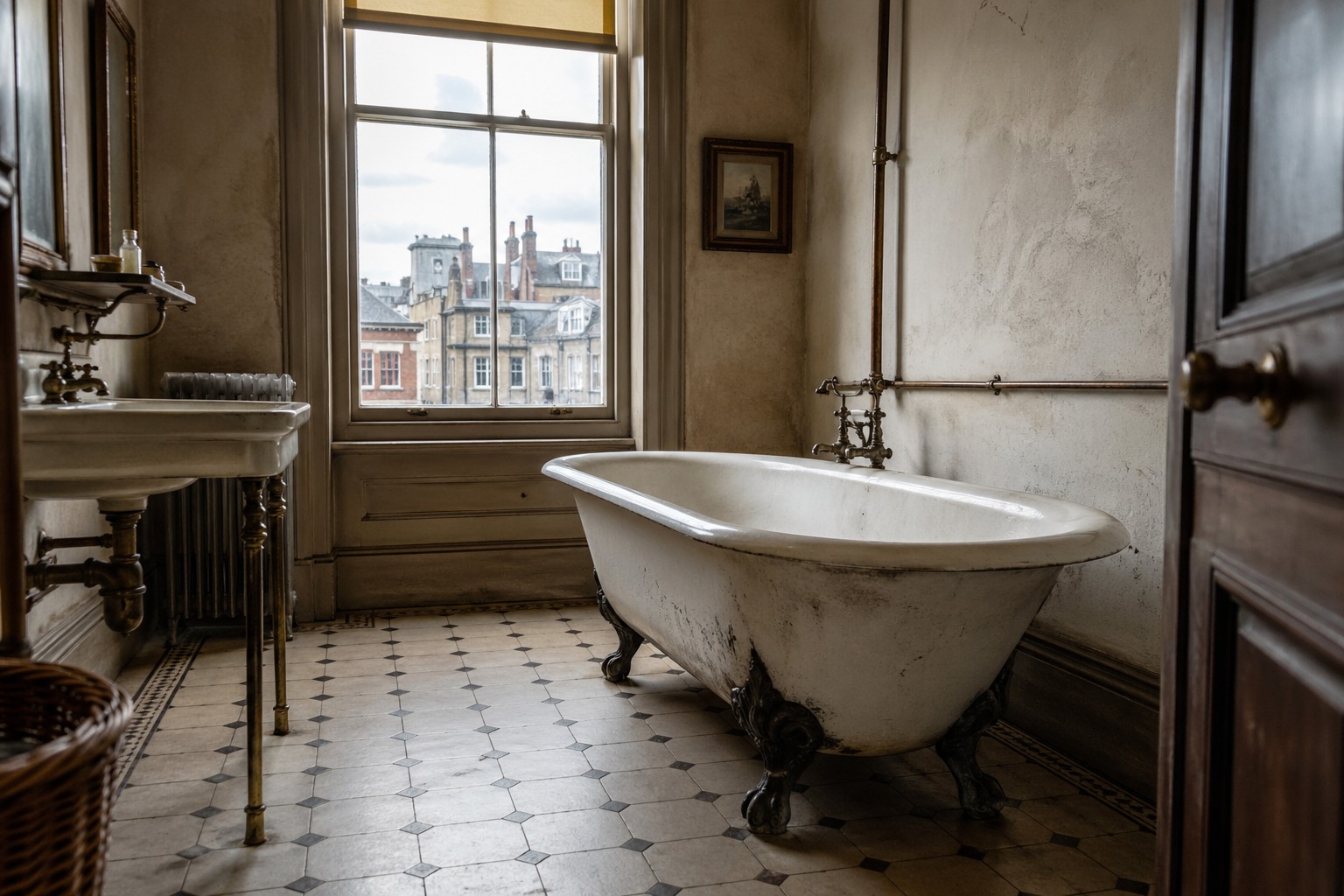
Yes – you can remove rust stains from your bathtub. Even the ones that look like someone has been storing Tudor artefacts in your plumbing. The good news lands first because, if you live in a Victorian terrace in Hackney, an Edwardian semi in Chiswick, or an inter-war mansion flat in Pimlico, you have almost certainly stood over a bathtub and wondered whether those orange-brown streaks are a permanent feature or a solvable problem. They are solvable. Mostly.
London’s period housing stock is genuinely magnificent – a living catalogue of architectural history that the rest of the world quietly envies. But behind those original sash windows and dado rails lies pipework that was installed when Queen Victoria was still deciding what to wear to dinner. Ageing iron and steel pipes shed rust particles into the water supply, and those particles end up decorating your bathtub in shades that no interior designer would recommend. This article walks you through exactly why it happens, how to fix it, and how to keep it from coming back.
Why Old Pipes in Period Properties Cause Rust Stains in the First Place
The Hidden Culprit Behind Those Orange Streaks
Iron and steel pipes do not fail dramatically. They corrode slowly – patiently, almost – over decades, releasing microscopic ferrous particles into the water flowing through them. When those particles hit a wet surface and meet oxygen in the air, they oxidise, forming iron oxide. Which is, of course, rust. The reddish-brown streaks running from your taps down to the plug hole are essentially the same process happening to your bathtub as happens to an old garden gate left out in the rain.
This is particularly prevalent in London properties built before the 1970s, many of which still retain original galvanised iron or, in some cases, lead supply pipes. London’s notoriously hard water compounds the problem considerably. The high mineral content leaves calcium and limescale deposits on surfaces, and those deposits act like velcro for rust particles – trapping them against the enamel or acrylic rather than allowing them to rinse cleanly away. The result is staining that builds up incrementally, deepening in colour and stubbornness with every passing month.
Assessing the Stain – Know What You’re Dealing With Before You Start
Light Surface Staining vs. Deep-Set Rust Deposits
Before reaching for the cleaning products, spend two minutes actually looking at what you have. Run your fingertip over the stained area. If it feels smooth and the discolouration sits on top of the surface glaze – faint, perhaps slightly orange – you are dealing with fresh or light staining, and the outlook is very good. If it feels rough or slightly gritty, or if the surface around the stain appears crazed, pitted, or finely cracked, rust particles have been working their way into damaged glaze for some time. That requires a more methodical approach and realistic expectations.
Your bathtub’s material matters enormously here. Cast iron enamel tubs – the heavy, deep-sided baths most common in Victorian and Edwardian London homes – are durable but not indestructible; once the enamel glaze is scratched or crazed, rust embeds itself stubbornly. Pressed steel enamel tubs behave similarly. Acrylic and fibreglass baths, more common in post-war and refurbished properties, are softer and considerably more vulnerable to abrasion. Knowing which you have before you start prevents you from accidentally making the situation worse.
The Cleaning Arsenal – Choosing the Right Products and Tools
Natural Remedies That Actually Work
For light to moderate staining, the contents of your kitchen cupboards will take you a surprisingly long way. White vinegar, lemon juice, bicarbonate of soda, cream of tartar and table salt are not folk remedies from a well-meaning aunt – they work because the mild acids they contain (acetic acid in vinegar, citric acid in lemon juice) dissolve iron oxide at a chemical level.
A reliable approach: make a paste of lemon juice and cream of tartar, apply it generously to the stained area, leave it for thirty minutes to an hour, then work it in gently with a soft cloth or sponge. Alternatively, pour neat white vinegar over the stain, sprinkle with bicarbonate of soda, and allow the fizzing reaction to do some of the lifting before scrubbing lightly. These methods are safe on all bathtub materials. They will not, however, perform miracles on staining that has been accumulating since the Blair government.
Specialist Rust Removers – What to Look For (and What to Avoid)
When natural remedies are not cutting it, purpose-made rust removers are the sensible next step. Oxalic acid-based cleaners – Bar Keepers Friend being the most widely available in the UK – are excellent for this. They work by chelating iron oxide molecules, essentially binding to them and lifting them away from the surface. Phosphoric acid-based products perform similarly and are stocked in most UK hardware retailers.
Two things to avoid with absolute conviction: abrasive powders on soft surfaces, and bleach. Abrasive cleaners scratch acrylic and fibreglass irreparably, and even on enamel they wear down the protective glaze over time. Bleach, however, is the most critical one – it does not touch rust, and worse, it can chemically set iron oxide staining, turning a manageable problem into a permanent feature. If there is a single thing to take from this entire article, it is this: do not use bleach on rust stains.
Step-by-Step: How to Remove Rust Stains from Your Bathtub
The Method That Works for Most Period Property Tubs
With your product chosen, here is the process that reliably delivers results on the cast iron enamel tubs most commonly found in period London homes:
- Dry the bath completely first. Products work far better on a dry surface, and residual moisture dilutes your cleaner before it has a chance to act.
- Apply your chosen cleaner – paste or liquid – directly to the stained area. Do not be shy with the quantity.
- Allow it to dwell. For oxalic acid cleaners, fifteen to twenty minutes is usually sufficient. For particularly stubborn deposits, leave it considerably longer.
- Work the area with a non-scratch nylon pad or soft sponge, using small circular motions. Do not scrub aggressively – let the chemistry do the work rather than the elbow grease.
- Rinse thoroughly and assess. Repeat the process if needed; a second or third application often shifts what the first loosens.
One firm rule for enamel tubs: never use steel wool or wire brushes. They feel satisfyingly effective in the moment, but they leave micro-scratches in the glaze that will trap rust particles far more readily in future. You will have solved Tuesday’s problem whilst methodically creating every Tuesday after it.
When DIY Isn’t Enough – Knowing When to Call the Professionals
The Signs That a Bathtub Needs Expert Attention
There are several situations where the most sensible course of action is to hand the job to someone with the right experience and equipment. If rust staining returns within a few weeks of thorough treatment, that is not a cleaning problem – it is an active corrosion problem in the pipework, and no amount of scrubbing will keep pace with it. Similarly, if the enamel surface is extensively crazed, the microscopic crevices harbour rust faster than surface cleaning can address.
Heritage and antique freestanding baths – the kind of roll-top cast iron piece that appears in every period property estate agent photograph ever taken – warrant particular caution. Incorrect products can etch original enamel, strip decorative finishes, or damage ball-and-claw feet. The cost of professional restoration on a genuine Victorian roll-top far exceeds the cost of getting the cleaning right in the first place. Landlords managing multiple period properties across London will also recognise that a systematic, professional approach is simply more efficient than repeated, inconsistent DIY attempts across a portfolio.
Preventing Rust Stains from Coming Back
Short-Term Habits That Make a Real Difference
Prevention is considerably less effort than cure, and a handful of consistent habits can dramatically slow the rate of re-staining. Wiping the bath dry after each use removes the standing water that facilitates iron particle deposit. A monthly application of a mild acid-based maintenance cleaner – diluted white vinegar or a cream of tartar paste – stops mineral and iron build-up before it becomes visible. Fitting an inline sediment filter to the bath’s supply line is a modest investment that catches ferrous particles before they reach any surface at all.
The Long-Term Fix – Talking to Your Plumber
Here is the honest truth: cleaning is a management strategy, not a permanent solution. The underlying pipe corrosion will continue regardless of how diligently you scrub. At some point, a conversation with a qualified plumber about partial re-plumbing, pipe relining, or the installation of a whole-house sediment filter becomes the more economical choice.
This conversation is worth having sooner in London properties that may still be partially served by original lead pipework. Lead pipes are a health concern that goes considerably beyond bathtub staining, and Thames Water offers a lead pipe replacement scheme for supply pipes on their side of the boundary. A WRAS-approved plumber can assess what lies within the property itself.
A Note on Period Properties and the Cleaning Approach They Deserve
London’s period homes are not just buildings – they are accretions of history, each one carrying more than a century of lives lived within their walls. The original cast iron baths, the encaustic floor tiles, the marble fireplace surrounds – these are features worth preserving properly, not attacking with the wrong product in a hurry.
Caring for them well means understanding the materials, respecting their age, and knowing when to reach for professional expertise rather than improvising under the bathroom light at half ten on a Sunday. The rust stains caused by old pipes are one of the more stubborn challenges that period property owners across Greater London face regularly – but they are far from insurmountable. With the right knowledge, the right products, and a methodical approach, that orange tide line is very much defeatable.